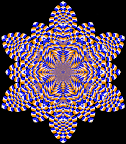
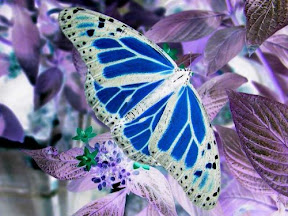
Description Presented here is a vast gallery of many different forms of Optical Illusions. Whether these optical illusions are conveyed through fractals, photographs, architecture, art, or old fashioned pen and ink, they are bound to remind you that "seeing is not believing."
Caution!!!!Some of the optical illusions on this blog may cause dizziness or possibly epileptic seizures. The latter happens when the brain can't handle the conflicting information from your two eyes. If you start feeling unwell when using this website, immediately cover one eye with your hand and then leave the page. Do not close your eyes because that can make the attack worse.
This illusion was created by David MacDonald. He describes the process,
"All my images are made the same way. I create a "matrix" in CorelDRAW according to strict rules of perspective, except for the false connections. This is then brought into Photo-Paint where it is "rendered" with purpose-taken, digitally photographed textures and objects. A print-out of the matrix is used as a reference guide during photography to help ensure that the objects are photographed with the correct point of view to fit."
This illusion took "in the region of sixty purpose taken photographs."
A wonderful blend of photography and digital imaging.
Below is a 3d kaleidoscope from Tekhna3d.com it is part of their experimental net3d model. There are many other interactive 3d demos to checkout on their site. Some you just move the mouse and others clicking the left mouse button moves you through the landscape.
This item requires that you have Macromedias Flash to run it. If the kaleidoscope is giving you problems, center the image then point your mouse over the image and press the right mouse button, now select restart.
If the kaleidoscope is giving you problems, center the image then point your mouse over the image and press the right mouse button, now select restart.
I found this on Hans Kuiper 's Math Art page. I didn't really understand what I was looking at but it was very cool. I continued to poke around the site further and came across the next image. He explains this image in an article first published in the magazine Arthesis, July 2002.
Is it possible to create a piece of Art, which looks, seen from 6 different views, like a chessboard, using only 64 cubes?
That is what I asked myself, having visited a Minimal Art Exhibition in the Gemeente Museum in The Hague, seeing work from Sol LeWitt, an artist of the Minimal Art movement. I read about LeWitt, that in his vision, the idea behind the art work is much more important then the construction of Art itself. But in my thoughts I saw my Chessboard "Cube" right in the middle of a roudabout, on the crossing of two regtangular ways. On your way to the roundabout you see in front of you the view of the Chessboard, while driving on the roundabout, you experience the anamorphosis, an optical illusion, because the position of each cube to the other cubes changes permanently. Leaving the roundabout you see in your rear-view mirror again the chessboard, independently if you leave at 1/4, 1/2 or 3/4 of the full circle. Read the whole article here.
I found these images on "Beyond Escher for Real" here they took Escher like impossible images and recreated them with some 3d modeling software. From their page they say,
Herein again, we show that many of the illusions look impossible yet could be realized. This work below presents some of these three-dimensional models that were designed and built using geometric modeling and computer graphics tools.
The following is the "Folded Chess Set" by Sandro Del-Prete. The top image models the original drawing from the original perspective. In the bottom image they take the model they built and rotate it to expose how it could be constructed.
"Folded Chess Set" by Sandro Del-Prete
Click here to see a movie rotating the model from front to side.
The below illusion was done by Eric Piotrowski, he took his inspiration from the classic impossible chess set. His site is full of 3d art based on the game Go.
The Zoom Quilt is a patchwork of images sewn together to give you the illusion of a 3d world. It is a collaborative art project based on Macromedia Flash that illustrates what a 3D Zooming User Interface (ZUI) might look and feel like.
The documents distributed here have been presented on this blog in the spirit of providing an entertaining venue to educate those interested in optical illusions.
All Flckr.com photos are presented here via Flckr's "blog this" feature. This feature is enabled by each artist on Flckr. If you find material here that belongs to you and you would like to have it removed or credited please contact me and I will gladly follow your wishes.
Copyright and all rights therein are maintained by the authors or by other copyright holders. It is understood that all persons copying this information will adhere to the terms and constraints invoked by each author's copyright. These works may not be reposted without the explicit permission of the copyright holder.


 I found this on Hans Kuiper 's
  the anamorphosis, an optical illusion, because the position of each cube to the other cubes changes permanently. Leaving the roundabout you see in your rear-view mirror again the chessboard, independently if you leave at 1/4, 1/2 or 3/4 of the full circle. Read the