Here are a couple of fascinating creations by artist Peter Callesen the first creation is a closeup of the original piece. The only material used is Acid free paper, pencil, and glue.
I love the skill and creativity of this artist. Is this skeleton breaking free of his two dimensional chains or settling in for a nice long nap.
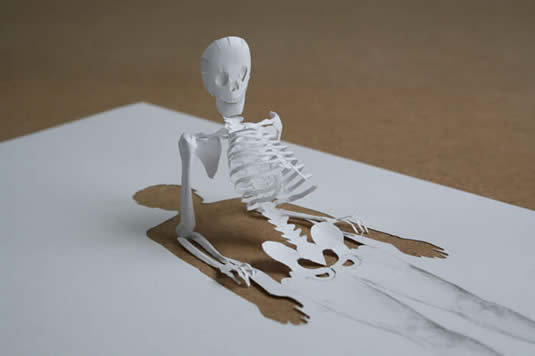
Half Way Through (Detail view)
Peter Callesen
(c)2006
This image is also just paper and glue. Makes me yearn to be a kid, just to have the chance to play with the glue again. Check out Peter's other works at his site.

Looking back
Peter Callesen
(c)2006
Peter, You do great work. Well Done!
There are many illusion forms that snow can take. Calvin is a master of the snow illusion as demonstrated below in Calvin's "Snowman House of Horror" and his "Swimmer and the Snow Sharks".
"Snowman House of Horror"
"Swimmer and the Snow Sharks"
Of course these illusions can be created in real snow also. Below they have had to rope off an area to keep people away from the rare snow lizard.
Of course you have to watch out for those giant snow big wheels. This one might have hurt someone. They were lucky this time but really parents have to watch their kids closer.
The real illusion of snow can be seen clearly in this snow scene. Not the fact that Bambi's father's spirit can be found watching over him, but the blanket of white snow that covers everything.
Snow itself is the true illusion. We walk in it, play in it and shovel it off of our driveways. The whole time we are under the spell of the illusion of snow. What do we see? White, piles and piles of white fluffy snow. The truth is snow is not white, it is composed of billions of snow flakes each one a unique work of art. You can see how these snowflake photographs were taken by going to
this site.


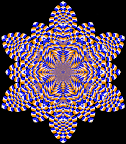
 I found this on Hans Kuiper 's Math Art page. I didn't really understand what I was looking at but it was very cool. I continued to poke around the site further and came across the next image. He explains this image in an article first published in the magazine Arthesis, July 2002.
Is it possible to create a piece of Art, which looks, seen from 6 different views, like a chessboard, using only 64 cubes?
That is what I asked myself, having visited a Minimal Art Exhibition in the Gemeente Museum in The Hague, seeing work from Sol LeWitt, an artist of the Minimal Art movement. I read about LeWitt, that in his vision, the idea behind the art work is much more important then the construction of Art itself.
But in my thoughts I saw my Chessboard "Cube" right in the middle of a roudabout, on the crossing of two regtangular ways. On your way to the roundabout you see in front of you the view of the Chessboard, while driving on the roundabout, you experience the anamorphosis, an optical illusion, because the position of each cube to the other cubes changes permanently. Leaving the roundabout you see in your rear-view mirror again the chessboard, independently if you leave at 1/4, 1/2 or 3/4 of the full circle. Read the whole article here.