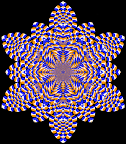
Here is an anomalous motion/distorted perception illusion.
The apparent motion induced by the blue spots seems to cause the red lines to bend and wave. If the whole image is in motion how could red lines not be bending with the motion?
These types of motion images confuse the eye and brain. This confusion allows the viewer to perceive motion in a static image. That's right the below image is a static image and is not animated in any way.
Herman has an excellent collection of Pop art, Paintings, and Optical illusions. He has given me permission to feature his pieces here. This is just one of many. His illusion art ranges from color perception to distorted illusions.
Thank You for sharing these excellent illusions Herman.
*** Herman J. Verwaal's Trick Art, Pop Art, and Fine Art are available for purchase.
The photo artist says the following about this image,
"Here is an optical illusion from Little Wild Horse Canyon in Goblin Valley Utah. The pictures are the same shot just one is turned upside down."
My question is which perspective is real the holes or the bumps?

Optical Illusion
Flickr Artist: jiggerpressTags: photos,
optical_illusions,
illusions,
art
This image appears at first and second glance to be tilted to the right.
The truth is though that the gate is perfectly straight up and down and all rows are perfectly horizontal.
To prove this step back from the monitor and the illusion slowly starts to fade.

Herman has a large collection of optical illusions that he has created over time. He has generously allowed me to feature a few of his pieces here. This is just one of many (check the
sitemap for his others). His illusions run the gambit and I will be showing you more of his excellent Trick-Art in the future.
Thank You for sharing these excellent illusions Herman.
*** Herman J. Verwaal's Trick Art, Pop Art, and Fine Art available for purchase
here.
Tags: photos,
optical_illusions,
illusions,
art
Spirals or concentric circles? Look at the figures below, What do you see? Are both of these images of spirals plummeting toward the center or does one of these images have only concentric circles?


The truth here is that both images are of concentric circles. The top image is very hard to believe and many of you will mark up your screen with finger prints trying to trace the circles. Here is a little hint, trace the circles on the top image in a clockwise direction otherwise you could go crazy and swear that I'm lying to you.
I've seen this illusion around the net and it seems to me that the red lines in this image must be effected by the gravitational pull of the circles. Normally 2 dimensional pictures don't have that strong a gravitational field but this image must use special high mass color in the center of these circles, how else could we explain the way the straight lines are pulled off center.

I just checked and the lines are actually straight. I guess the gravity of the special color must be effecting the way we see these lines, almost as if an optical illusion is causing us to view straight lines as wavy lines.
What am I saying the title of this site is Optical Illusions Etc..., so of course this is another optical illusion that causes us to view straight lines as curved lines.
Check out
this site to see this illusion with and without the circles, just move your mouse over the orange bar at the bottom.
The below two images are quite interesting. The image on the left gives us the impression of having 5 holes and 1 bump. The image on the right looks like it has 5 bumps and 1 hole. What makes this a fascinating optical illusion is the fact that these are the exact same image.


That's right these two images are identical, one is turned upside down. The simple act of turning this image upside down completely changed our assessment of the image.
The reason for this is that the brain assumes that light comes from above. For centuries the best light source was the sun (came from above). Now we have various sources of light but one thing most of them have in common is that designers typically put all major light sources above us. This is a very strong predisposition on our part. Thus we view shadows and light with the assumption that the light is coming from above.
Another example can be seen below. The top image seems to be a large dome, could this be a
lava dome preparing to erupt?

No of course not. This is not a lava dome, below we flip it back to where we started. Most of you will recognize this landmark.

Barringer Crater on Earth
Credit: D. Roddy (LPI)
In this image it is clearly the Barringer Meteor Crater in Arizona. The only thing done to this image was the top picture was turned upside down. I got this image from the
Astronomy Picture of the Day.
Here we think of this as an interesting effect and no more than that. But analysts viewing pictures from other planets often analyze the image from the wrong perspective. Many times these pictures end up in science magazines and journals (
one example here) completely upside down and misrepresented.
Go to this page to read more about the problems that some analysts have in getting past this optical illusion. Scan down the page and you'll see many examples of errors in astronomy reporting and analysis.
Here is another excellent creation by Aiyoshi Kitaoka he is a master of the art. In the below optical Illusion the black and blue columns actually are all perfectly straight and intersect at 90 degree angles.
"Waterways"
Waterways appear to tilt alternately, though they are parallel to each other. Moreover, "water" appears to swing in the horizontal directions.
Copyright Aiyoshi Kitaoka 2005 (February 15)
I found this at Archimedes-Lab. The graphic poses the question "Straight or not?" Being an optical illusion it wouldn't be posing the question if the answer wasn't that each is a square with perfectly straight sides.

Hard to believe? I agree so don't trust me get out the straight edge and check it out. Or if you must print it out and fold or cut along the edge. No matter how you check the image the edges will be straight every time.
I had seen this illusion before but for some reason never really focused on it before. Today I saw it on Coach Burke's site and actually read the info. This exposure caused me to search out some additional info and create this post.
This is Roger Shepard’s “Turning the Tables” illusion. Look at the two tables below. If I told you they had an equal surface area on their table tops, you'd probably say "maybe". But what if I told you that they also were identical in both length and width. Don't believe me? Measure them for yourself. This optical illusion appeared in the Jan. 2003 issue of Discover Magazine.
The below image is given so you can print it out, make a cutout of a tabletop, and reposition it over the other one.
 Click on picture to go to another solution page for this illusion.
Update: I found this interactive
java applet on the Rice University site hosted in their psychology department's space. The applet allows you to really examine this illusion.
Here is the famous Cafe Wall illusion. This effect is another mind altering trip. The lines are all parallel to each other and straight as an arrow.
The background below is from the
Exploratorium in San Francisco, CA. They have an outstanding site start with thier animation of
this illusion so you can better understand the effect.
The Cafe Wall Illusion was first described by Dr. Richard Gregory. Dr. Gregory is a good friend of the Exploratorium and director of The Exploratory Hands On Science Museum in Bristol, England. Dr. Gregory observed this curious effect in a pattern of tiles on a cafe wall in Bristol.... Note that the effect is not visible in the picture due to the small scale of the tiles.
Below are two perfectly concentric circles. One floating perfectly centered in the other. I hear a murmur of disbelief.... Print it out and measure it for yourself.
"Kitaoka Strange Appearance"

I think this may have been created by Akiyoshi Kitaoka.